Parenting in the Digital Age: Boundaries, Balance & Bonding

Understanding Your Child’s Inner World: The Root of All Behaviour
March 11, 2026
How Your Own Childhood Shapes Your Parenting Style
March 11, 2026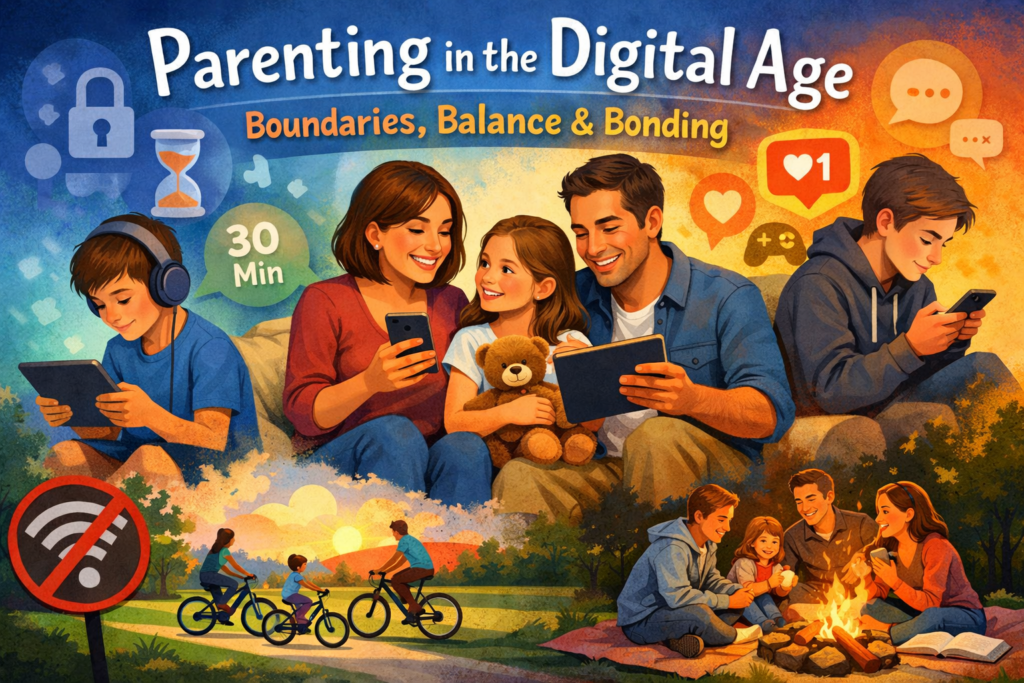
Screens are everywhere. From online classes to entertainment, from social connections to information—technology has become an inseparable part of our children’s lives.
As parents, we often find ourselves torn between concern and convenience. We worry about screen addiction, reduced attention spans, and emotional disconnect. At the same time, we rely on digital tools to manage daily life.
Parenting in the digital age is not about eliminating screens.
It is about using them wisely.
Understanding the Digital Reality
Children today are digital natives. They are growing up in a world very different from the one we experienced. For them, screens are not a luxury—they are a language, a classroom, and a social space.
Dismissing technology completely can create resistance and conflict. Accepting it without boundaries can create dependency.
The key lies in understanding, not extremes.
Why Boundaries Matter
Boundaries provide structure and emotional safety. Without clear limits, children struggle to regulate themselves.
Healthy digital boundaries include:
- Defined screen-time routines
- Screen-free zones (like dining areas and bedrooms)
- Clear expectations about content
Boundaries work best when they are consistent, age-appropriate, and explained calmly.
Rules imposed without understanding often lead to power struggles. Boundaries created with dialogue encourage cooperation.
Balance Over Control
Balance means recognising that screens are only one part of a child’s life—not the centre of it.
Encouraging balance involves:
- Physical play and movement
- Creative activities
- Quiet, screen-free moments
- Family conversations
When children experience a rich variety of engagement, screens naturally lose their overpowering hold.
Balance is built gradually, not overnight.

The Missing Piece: Bonding
Often, excessive screen use is not about technology—it is about connection.
Children turn to screens when:
- They feel bored
- They feel lonely
- They seek stimulation or comfort
Strong bonding reduces this dependence.
Simple moments of connection—listening, laughing, shared routines—create emotional security. When children feel emotionally fulfilled, screens become a tool, not an escape.
Role Modelling Matters More Than Rules
Children observe us more than they listen to us.
If parents are constantly on their phones, children receive a silent message about priorities. Creating healthy digital habits starts with self-awareness.
Small changes—putting the phone away during conversations, limiting personal screen use—make a big difference.
Conversations Over Restrictions
Instead of constantly monitoring or restricting, talk to children about:
- Online safety
- Digital responsibility
- Emotional impact of content
Open conversations build trust and prepare children to make informed choices as they grow.

A Balanced Digital Future
Parenting in the digital age is not about perfection. There will be days of overuse, frustration, and guilt. What matters is reflection and course correction.
At IDEACONS, we believe that when parents combine clear boundaries with emotional bonding, children learn to navigate the digital world responsibly.
Because technology should support childhood—
not replace it.